*** Free consultation ***
Beyond Exhaustion: Navigating Mental and Emotional Burnout
In endurance sport, we understand the difference between productive fatigue and overtraining. A hard session leaves you tired but stronger. Chronic overload without recovery, however, leads to breakdown. The same principle applies in life and work. Mental and emotional burnout isn’t simply feeling tired after a long week, it’s the cumulative result of sustained stress without adequate restoration. For triathletes and high performers alike, the drive to push through discomfort can become a liability. We pride ourselves on resilience, discipline, and doing “one more rep.” But when output continually exceeds input, physically, mentally, and emotionally, performance declines across the board. In this article, we explore what burnout truly is, why it happens, and how to strategically recover before exhaustion turns into something deeper.
HEALTH THROUGH SPORTTRAININGRECOVERYPERSONALISED COACHING
James Oswald, Coach
3/9/20263 min read
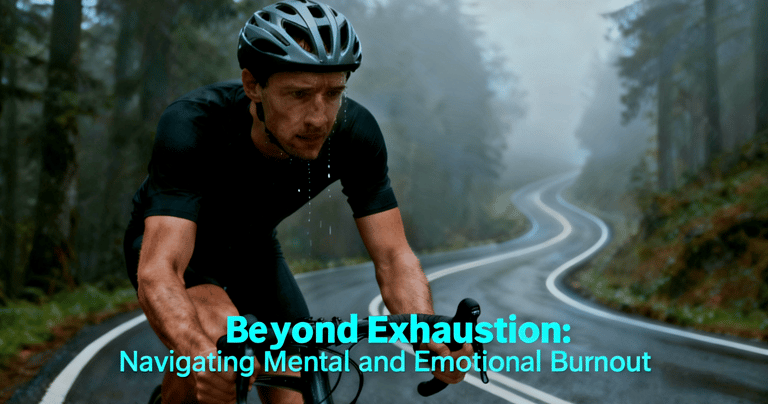
Beyond Exhaustion: Navigating Mental and Emotional Burnout
Burnout is often dismissed as mere tiredness, but it is a complex physiological and psychological condition. Unlike standard fatigue, which a weekend of sleep can fix, burnout is the result of prolonged exposure to chronic stressors. It is the state of being "emptied out," where the internal resources required to function have been completely depleted.
The Three Pillars of Burnout
To address burnout, we must first recognise its primary components as defined by psychologists:
• Emotional Exhaustion: This is the core of burnout. You feel overextended and fatigued by your work or personal life. It manifests as a lack of energy to face even simple social interactions.
• Depersonalisation (Cynicism): You begin to develop a cold, indifferent, or even hostile attitude toward your responsibilities and the people involved in them. This is a defence mechanism used to cope with the overwhelm.
• Reduced Personal Accomplishment: Even when you achieve something, you feel no satisfaction. A persistent sense of "what’s the point?" settles in, leading to a decline in competence and self-worth.
The Hidden Causes
While overwork is the most cited cause, burnout often stems from a lack of alignment.
1. Lack of Control: Feeling like you have no control over your schedule, assignments, or environment.
2. Reward Imbalance: Putting in high levels of effort but receiving little recognition, financial compensation, or intrinsic satisfaction.
3. Value Conflict: Being forced to perform tasks or exist in environments that contradict your personal ethics or long-term goals.
The Physical and Mental Toll
Burnout is not "all in your head." Chronic stress keeps the body in a constant state of "fight or flight," flooding the system with cortisol. Over time, this leads to:
• Physical symptoms like frequent headaches, digestive issues, and a weakened immune system.
• Cognitive impairment, including "brain fog," memory loss, and an inability to concentrate.
• Increased risk of anxiety disorders and clinical depression.
Strategic Recovery and Prevention
Recovery is not about a temporary escape; it is about systemic change.
The Power of "Selective Neglect"
You cannot do everything. Recovery involves identifying non-essential tasks and intentionally neglecting them to preserve energy for your health. This requires auditing your daily "to-do" list and removing items that do not serve your primary goals or well-being.
Micro-Rest vs. Macro-Rest
A two-week vacation is a "macro-rest" that provides a temporary break, but "micro-rests" prevent burnout from recurring. These are 5 to10 minute intervals throughout the day where you completely detach from screens, phones and demands.
Re-establishing Control
Start small to regain a sense of control. Whether it is reorganising your workspace or setting a strict "no-email" boundary after 6:00 PM, these small victories help signal to your brain that you are no longer a victim of your circumstances.
Professional Support
Because burnout affects the brain's executive function, it can be difficult to plan your own recovery. Consulting a therapist or coach can provide the external perspective needed to identify stressors you may have become blind to, and identify ways to change or cope.
Final Thoughts
Burnout is a sign that your life's "output" has significantly exceeded your "input" for too long. It is a protective signal from your body demanding a recalibration. By acknowledging the severity of the exhaustion and implementing structural changes to your boundaries and expectations through talking and the support of others, you can move from a state of survival back into a state of thriving.
Conclusion
Training for triathlon teaches us that adaptation only happens when stress is balanced with recovery. Ignore recovery long enough, and performance stalls. Ignore it even longer, and injury or illness follows. Burnout operates the same way in work and life. It is not weakness; it is a signal.
Just as a smart endurance athlete adjusts their training load, burnout demands recalibration. That may mean setting firmer boundaries, realigning your efforts with your values, or seeking professional guidance. Sustainable success, whether in racing, career, or personal growth, requires respecting your limits as much as you respect your ambitions. When you learn to manage energy, not just output, you move from surviving your responsibilities to performing with purpose and longevity.
Are you interested in learning about how to restructure your daily routine to incorporate more high-quality recovery time?