*** Free consultation ***
From 70.3 to 140.6: Taking the Step Up to Full Distance Triathlon
Moving from a 70.3 triathlon to a full-distance 140.6 event is one of the biggest and most exciting challenges in endurance sport. While a middle-distance race already demands serious fitness, commitment, and resilience, stepping up to full distance introduces an entirely new level of preparation, strategy, and mental strength. Having completed 12 full-distance triathlons and 14 middle-distance races I understand firsthand that the transition is about far more than simply training longer. Success over 140.6 requires smarter pacing, disciplined fuelling, consistent recovery, and learning how to balance training alongside work, family life, and everyday responsibilities. In this blog, I share my own experience of making the jump from 70.3 racing to full-distance triathlon, including the key physical and mental differences athletes should expect, common mistakes to avoid, and why personalised coaching can make a huge difference when preparing for one of the toughest endurance challenges in sport.
PERSONALISED COACHING140.6CHALLENGE ROTHIRONMANOUTLAWTRAININGRACE DAY
James Oswald, Coach
5/29/20264 min read
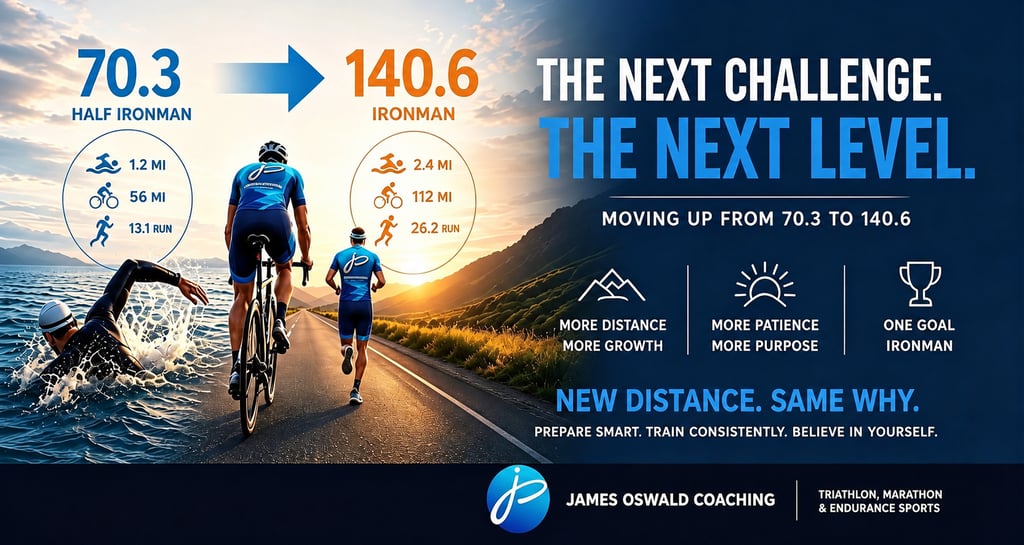
From 70.3 to 140.6: Taking the Step Up to Full Distance Triathlon
By James Oswald – James Oswald Coaching
Making the jump from a 70.3 to a full-distance 140.6 triathlon is one of the biggest and most rewarding steps an endurance athlete can take.
For many athletes, completing a 70.3 feels huge. And rightly so. A 1.9km swim, 90km bike, and half marathon is a serious challenge that requires commitment, fitness, and resilience. But some athletes intentionally use it as a stepping stone, whilst for some athletes, curiosity starts creeping in…
“What would it feel like to go longer?”
Having completed 12 full-distance triathlons myself, alongside 14 middle-distance races, I can honestly say that while the two distances share similarities, the experience of racing a 140.6 is completely different.
It’s not simply “double a 70.3.”
It’s a different challenge physically, mentally, emotionally, and logistically.
But it’s also one of the most rewarding experiences you can have in sport.
The Biggest Change: Respecting the Distance
One of the first lessons athletes learn when moving up to full distance is that you absolutely cannot fake an Ironman.
In a 70.3, you can often get away with small pacing mistakes, slightly poor fuelling, or pushing a little too hard early on. In a full-distance race, those mistakes almost always catch up with you eventually.
Usually somewhere around mile 18 of the marathon.
The athletes who race well over 140.6 sometimes are not the fastest athletes on paper. They’re often the athletes who show the most patience, discipline, and consistency throughout the entire day.
A full-distance triathlon rewards control rather than all out aggression.
Training Becomes More About Consistency Than Hero Sessions
One of the biggest misconceptions is that training for a full-distance triathlon means destroying yourself every weekend with massive sessions.
In reality, successful Ironman training is usually built around consistency. My philosophy is training smarter, to race stronger.
Yes, there are longer rides and longer runs involved especially in the last couple of months in the build up to pre-race, but the real key is being able to train week after week without breaking down physically or mentally, and still enjoying the training.
That means:
Managing recovery properly
Fuelling training correctly
Sleeping well
Avoiding injury
Balancing life stress alongside training stress
As a coach, one of the biggest things I try to help athletes understand is that training must fit around real life. The aim is to make you the best athlete, that you can be. That takes into account busy lives, work, family, social commitments.
Most age-group athletes are balancing:
Careers
Family life
Relationships
Children
Irregular working hours
Travel
General life stress
Trying to follow a generic “pro-level” training plan often leads to burnout very quickly, as can following a fixed plan from a book, website or AI. Adaption is key to future growth, continuity and also enjoyment.
A personalised coaching plan allows athletes to train effectively around their actual lifestyle, not against it.
Nutrition Suddenly Becomes a Massive Deal
You can sometimes survive a poorly fuelled 70.3. You rarely survive a poorly fuelled Ironman.
One of the biggest transitions when stepping up to 140.6 is understanding just how important nutrition becomes.
Over the course of a full-distance race, your body is burning thousands of calories while trying to sustain movement for anywhere between 9 and 17 hours.
Your body simply cannot store enough glycogen to complete the race without refuelling.
That means athletes need to practise:
Carbohydrate intake
Hydration strategies
Electrolyte replacement
Gut training
Timing nutrition properly
Fuelling under fatigue
The athletes who fuel consistently almost always finish stronger.
The Marathon Is a Different Beast
In a 70.3, you start the run tired. In a full-distance race, you start the marathon already deeply fatigued. That’s a huge difference.
Your legs have already:
Swum 3.8km
Cycled 180km
Burned thousands of calories
Been moving for hours
Then you still have a full marathon left.
The challenge becomes far more mental than many athletes expect.
There will almost always be low moments during an Ironman. The key is understanding that those moments are temporary.
Most experienced full distance athletes learn to:
Stay calm
Keep fuelling
Control pacing
Break the race down mentally
Focus only on the next small target
Learn to adapt to how the race unfolds
Sometimes it’s simply getting to the next aid station.
Every Full Distance Race Is Different
One thing I’ve learnt over the years is that no two 140.6 races are ever the same.
Course profiles, temperatures, road surfaces, wind, humidity, altitude, and swim conditions can completely change the demands of the day.
Some races become nutrition battles.
Others become pacing battles.
Some become survival exercises in extreme heat.
Others require managing cold temperatures and energy conservation.
Preparing specifically for your chosen race matters enormously. In a few weeks there's a blog ready to launch that looks at the factors to take into account when choosing the race/course you are going to enter next.
Recovery Takes Longer
Another major difference athletes often underestimate is the recovery after a full-distance event.
A properly raced 140.6 places huge stress on:
Muscles
Joints
Tendons
Hormonal systems
The immune system
Mental energy levels
Recovery isn’t just about resting for a couple of days.
It often takes weeks for the body to fully absorb the demands of a full-distance race. This is why smart pacing and proper preparation are so important.
Why Coaching Makes a Huge Difference
One of the biggest benefits of working with a coach when moving up to full distance is having structure, guidance, and experience throughout the process.
A coach helps remove the guesswork around:
Training load
Recovery
Nutrition
Race pacing
Tapering
Race-day execution
Balancing training with life
Most importantly, a good coach helps athletes arrive at the start line healthy, confident, and properly prepared.
Final Thoughts
Making the move from 70.3 to 140.6 is daunting. It should be, it's a bloomin' long way.
A full-distance triathlon commands respect.
But it’s also one of the most incredible journeys an athlete can experience.
The finish line of a 140.6 isn’t just about fitness. It represents months of consistency, sacrifice, resilience, and belief in yourself.
And from personal experience, crossing that finish line never loses its magic,
...No matter how many times you do it.