*** Free consultation ***
From Olympic Distance Triathlon to 70.3: Making the Leap to Middle Distance Racing
Stepping up from an Olympic Distance triathlon to a Middle Distance or 70.3 race is one of the most exciting transitions an athlete can make in endurance sport. It’s a step that brings bigger challenges, longer training days, smarter race strategies, and ultimately, even greater rewards. But while the jump in distance may look straightforward on paper, the reality is that Middle Distance racing requires a completely different approach to pacing, fuelling, recovery, and preparation. Having raced over 15 Middle Distance events himself, including Ironman 70.3 races, Challenge Family events, Outlaw Half, Cotswold 113, European Championships, World Championship races, and local middle-distance triathlons, James Oswald understands firsthand that no two races are ever the same. course profiles, weather conditions, technical bike sections, swim conditions and locations, road surfaces, and temperature can all dramatically change how a race unfolds. In this blog, we’ll explore what athletes should expect when moving up to the 70.3 distance, the common mistakes to avoid, and why having a personalised coaching plan can make all the difference when balancing ambitious goals alongside work, family, and everyday life.
70.3PERSONALISED COACHING140.6TRAININGRACE DAYIRONMANTRIATHLONOUTLAWCHALLENGE ROTH
James Oswald, Coach
5/15/20264 min read

From Olympic Distance to 70.3: Making the Leap to Middle Distance Racing
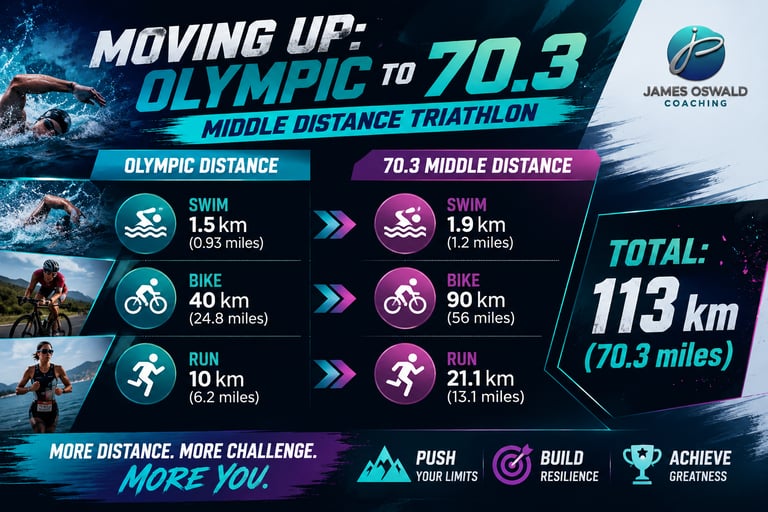
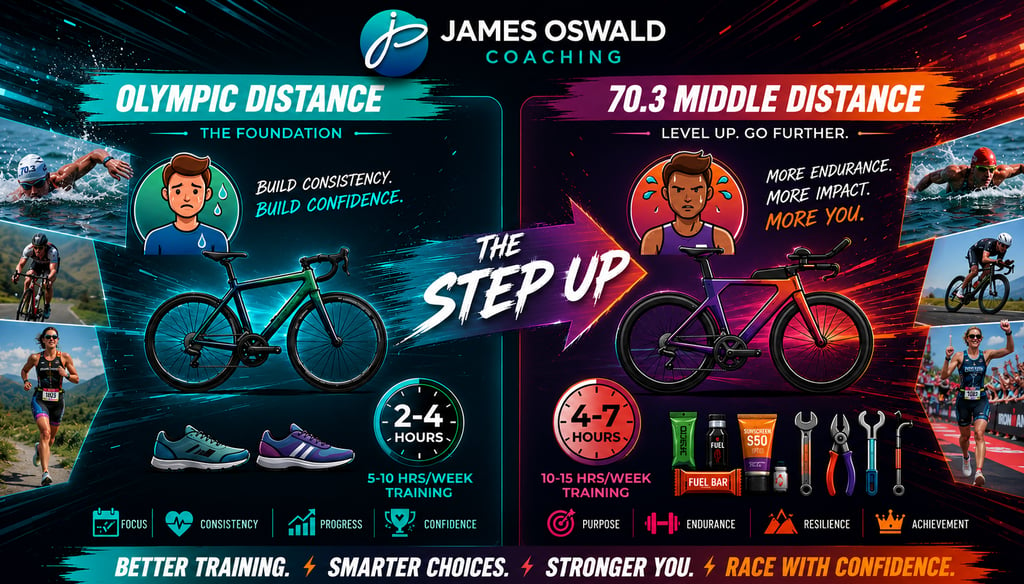
For many triathletes, completing an Olympic Distance triathlon feels like a huge achievement, and so it should. A 1.5km swim, 40km bike, and 10km run requires commitment, consistency, and determination. Racing at constant high effort for the duration of an Olympic Distance Triathlon can be nothing short of exhausting and strike fear into many a long course athlete. But once the dust settles after race day, many athletes start asking the same question:
“What’s next?”
For countless triathletes, the answer is digging deep for another Olympic Distance and a possible P.B. However, for some stepping up to Middle Distance racing, the iconic 70.3 distance seems the obvious progression.
Covering a 1.9km swim, 90km bike, and 21.1km run, Middle Distance racing offers a completely different experience. It’s longer, more strategic, and far more demanding from both a physical and mental standpoint. But it’s also one of the most rewarding journeys in triathlon.
At James Oswald Coaching, this progression is something I know extremely well. I’ve raced over 15 Middle Distance events, including races from Ironman, Challenge Family, Outlaw, Cotswold 113, European Championships, World Championship events, and numerous local races across varying terrains and conditions.
One thing I’ve learned over the years?
No two 70.3 races are ever truly the same.
Middle Distance Racing Is About More Than Just Distance
A common misconception is that a 70.3 is simply “a longer Olympic Distance race.”
In reality, the demands are very different.
One step up from a Sprint Triathlon an Olympic Distance race often allows athletes to continue to race aggressively from start to finish. In Middle Distance racing, pacing, patience, and energy management become absolutely critical.
A fast start or poor fuelling strategy can turn an enjoyable race into a survival exercise very quickly.
Success over 70.3 distance comes from:
Controlled pacing
Efficient fuelling
Strong aerobic endurance
Smart race day decisions
Consistent training over time
You don’t necessarily need to train harder, but in a way you do need to train smarter.
Every 70.3 Course Presents Different Challenges
One of the reasons Middle Distance racing is so exciting is that every course creates a completely different racing experience.
I have experienced this firsthand throughout my years of racing.
Some courses are fast and flat, rewarding sustained power and aerodynamic efficiency. Others feature relentless climbing, technical descents, rough road surfaces, open-water swim challenges, or extreme heat that can completely change pacing and fuelling strategies.
Factors that can massively influence your race include:
Water temperature and swim conditions
Technical bike sections
Climbing profiles
Some courses suited to road bikes others to TT bikes or road bikes
Road surface quality
Wind exposure
Heat and humidity
Cold temperatures
Disciplines being cancelled due to poor conditions
Aid station locations
Run terrain and elevation
Open or closed roads
A 70.3 in cool northern Europe can feel entirely different to racing in 30 or 40 degree heat abroad.
Understanding how to prepare for the specific demands of your chosen race is often the difference between simply finishing and genuinely performing well.
The Bike Leg Changes Everything
One of the biggest lessons athletes learn when moving up from Olympic Distance racing is just how important the bike becomes.
In shorter races, athletes can sometimes recover from a difficult bike leg during the run. Over 90km, mistakes on the bike usually come back to haunt you later.
Middle Distance racing rewards athletes who:
Ride within themselves early on
Fuel consistently
Stay aero and efficient
Manage effort over hills and technical terrain
Arrive at T2 with energy left to run well
The bike isn’t just part of the race anymore, it becomes the foundation for the entire day.
Nutrition Becomes a Key Performance Factor
Fuelling is one of the biggest transitions athletes face when stepping up in distance.
Many triathletes can get through an Olympic Distance race with minimal nutrition. That approach rarely works in a 70.3.
Middle Distance racing requires athletes to actively manage:
Carbohydrate intake
Electrolytes
Hydration
Caffeine strategy
Timing of nutrition
Gut tolerance during pro-longed exercise
Practising nutrition during training becomes just as important as practising swimming, cycling, and running.
I often remind athletes that successful Middle Distance racing isn’t just about fitness, it’s about preparation and execution.
Why Coaching Can Make a Huge Difference
As training time increases balancing Middle Distance training around work, family life, and other commitments can feel overwhelming without structure.
This is where working with a qualified coach can completely change the experience.
A personalised coaching plan helps athletes:
Train efficiently with the time they actually have available
Avoid unnecessary junk miles
Build fitness progressively
Reduce injury risk
Kit recomendations and prevent wasting money
Prepare specifically for their target race
Improve confidence leading into race day
Balance training alongside busy schedules and real life
Adjust training where required due to external factors
At James Oswald Coaching, the focus is always on creating realistic, sustainable training that works around the athlete, not forcing the athlete to fit around the training.
Because for most age-group triathletes, life doesn’t stop simply because a race is approaching.
Recovery and Consistency Matter More Than Ever
As training volume increases for 70.3 preparation, recovery becomes increasingly important.
Many athletes discover that improvements don’t simply come from training harder. They come from recovering properly and being able to train consistently week after week.
Sleep, nutrition, mobility, strength work, and managing stress all become important parts of the process.
The athletes who progress best are usually not the ones doing the biggest sessions, they are the ones who can stay healthy and consistent over time.
The Reward of Going Longer
Completing your first Middle Distance race is something special.
The journey requires patience, discipline, and belief in yourself. But it also teaches you how capable you truly are.
For many athletes, crossing the finish line of a 70.3 becomes far more than just completing another race. It becomes proof that they can handle bigger challenges than they once thought possible.
And once you finish your first one?
There’s a very good chance you’ll already be thinking about the next, or how about a full course !!!