*** Free consultation ***
Going Bananas: Mind-Blowing Facts About the Marathon
For most people, the word marathon immediately brings to mind 26.2 miles of determination, sore legs, blisters, chaffing, and a medal at the finish line. But behind that iconic distance lies a world of strange traditions, huge logistical efforts, and some genuinely surprising facts that most runners, and spectators, never think about. While watching or running a marathon, it’s easy to focus on the athletes and the clock. What we rarely consider is everything happening behind the scenes: the mountains of fruit being handed out, the historical quirks that fixed the race distance, the bizarre records people attempt in costume, and even the occasional marathon run in space. This blog started with a simple question: just how many bananas are handed out during the London Marathon? As it turns out, the answer opens the door to a whole collection of fascinating facts about one of the world’s most iconic endurance events. So, whether you’re a seasoned runner, a future marathon hopeful, or someone who prefers cheering from the sidelines, here are some mind-blowing, amusing, and downright unexpected facts about the marathon.
MARATHONPERSONALISED COACHINGFUELLINGHYDRATIONTRAININGRACE DAYRUNNING
James Oswald, Coach
3/20/20266 min read
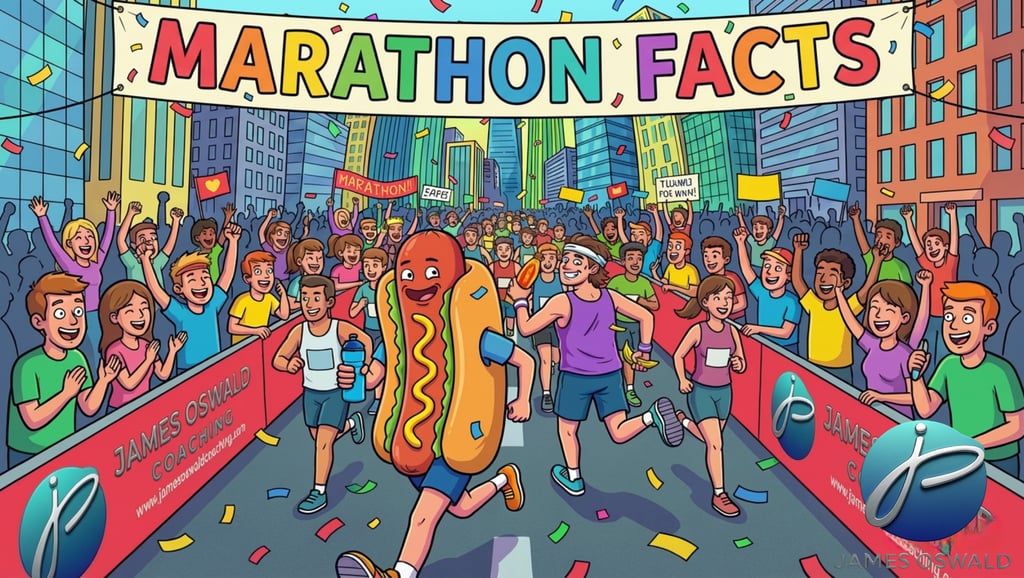
Whether you’re a seasoned ultra-runner or someone whose only experience with a marathon is watching it from the comfort of your sofa, there is no denying that 26.2 miles (42.195km) is a legendary distance. But beyond the sweat, blisters, chaffing and the medals, there are some truly staggering statistics that keep these races running.
I initially started this blog wondering how many bananas are served up to runners in the London Marathon but quickly found out a little more. From royal interventions to my answer on literal tons of fruit, here are some of the fascinating facts about marathons that I could find.
The London Marathon is "Bananas"
If you’re sad like me and curious to know how much fruit it takes to put on a leading marathon, then here’s your answer. Although, I’d still like to know the retail upsell in banana’s in London over the entire marathon weekend.
Every year, the London Marathon prepares approximately 30,000 to 40,000 bananas to hand out to runners at various refreshment stations. This helps participants stave off muscle cramps and maintain energy levels. If you lined those bananas up end-to-end, they would stretch for over 4 miles, that’s nearly enough to cover the distance from the Tower of London to the finish line at The Mall!
We Have the Royal Family to Thank for the Distance
Ever wonder why the distance is such a specific, awkward number like 26.2 miles? You can blame the British Royal Family.
Originally, marathons were roughly 25 miles. However, during the 1908 London Olympics, the route was extended so the race could start at Windsor Castle and finish right in front of the Royal Box at the Olympic Stadium. That extra distance stuck, and in 1921, the 26.2 miles became the official global standard.
Humans vs. Horses
In the town of Llanwrtyd Wells, Wales, they take marathon running to a different level with the Man versus Horse Marathon. It is exactly what it sounds like: runners compete against riders on horseback over a 22-mile course. Believe it or not, humans have actually won a handful of times, proving that on hot days and rugged terrain, our ability to sweat and regulate temperature gives us a competitive edge over our four-legged friends in endurance events. In fact, the Endurance Running Hypothesis presumes that humans evolved anatomical and physiological adaptations to outrun large animals through persistence hunting.
Running... Backwards?
While most people struggle to run a marathon facing the right way, some crazy athletes prefer a different view. Where I’d fall over in the first 10 meters, the world record for the fastest marathon run backwards is an incredible 3 hours, 43 minutes, and 39 seconds. Think you could go faster than that backwards, that would be a challenge for you and James Oswald Coaching. To put that into context that’s faster than the average time for most "forward" runners!
Out of This World
The marathon isn't just a terrestrial event. In 2007, astronaut Sunita Williams became the first person to run a marathon in space. She completed the Boston Marathon while circling the Earth on the International Space Station, finishing in 4 hours and 24 minutes while tethered to a treadmill to prevent her from floating away. In 2026, British astronaut Tim Peake’s ran the London Marathon remotely aboard the International Space Station in 3 hours, 35 minutes and 21 seconds (but could he do it backwards?).
The Oldest and the Largest
The Oldest: The Boston Marathon is the world’s oldest annual marathon, having been held every year since 1897. This is on the bucket list for nearly all marathon runners.
The Largest: The New York City Marathon currently holds the record for the most finishers, with over 50,000 runners crossing the line in a single day. I’m fortunate to have run the New York Marathon twice, with the first emotional time being just after 9/11.
N.R.G.
Approximately 200,000 to 250,000 units of Lucozade are typically distributed to runners during the London Marathon, though the exact format (bottles vs. other containers) has changed in recent years to improve sustainability.
That’s a lot of H2O
The London Marathon uses around 750,000 to 900,000 bottles of water in addition to the Lucozade they hand out. Where as the Manchester Marathon approximately 150,000 to 200,000 bottles of water are typically handed out to participants.
Free Drink Anyone?
One of my favourite parts of the Manchester Marathon is finishing and being given one of the approximate 30,000 to 35,000 cans of Erdinger Alkoholfrei (non-alcoholic beer) offered just past the finish line.
While the exact count can vary based on the number of registered finishers each year, It’s basically one drink per Finisher: Every runner who crosses the finish line is entitled to one complimentary drink as part of their "finisher rewards," alongside their medal and t-shirt. With the event now hosting around 32,000 to 36,000 participants, the supply is scaled to match this capacity.
Erdinger is the "Official Recovery Drink" of the race because it is isotonic and contains vitamins like B12 and folic acid, which help with muscle recovery and rehydration after 26.2 miles. It also tastes great !!
If you are planning to collect yours, make sure to keep your race bib visible, as staff usually check it to ensure every finisher gets their well-deserved drink, and trust me you don’t want to miss out!
But what about all the runners in fancy dress…
Fancy dress marathon records are a popular category, particularly at the London Marathon with approximately 70 and 80 runners officially registered to attempt a Guinness World Record in costume each year. In 2024, 44 of these records were successfully broken, and in 2025, 41 records were broken. However, while "fancy dress" ranges from a simple headband to a 10 person London bus costume, race commentators, organisers and spectators typically see thousands of runners (out of a total field of 53,000+) wear some form of costume each year for London alone. If you are planning to run in fancy dress, remember to think about overheating and definitely chaffing !!
Below are some of the fastest and most notable records as of recent updates that I’ve been able to find.
Top Speed Records
Some of the fastest "fancy dress" times around the world are remarkably close to elite paces, often set by experienced club runners or sub 2:30 marathoners.
- Superhero (Male): 2:27:43 by Matt Gunby (UK) dressed as Wonder Woman at the 2016 London Marathon.
- Superhero (Female): 2:48:51 by Camille Herron (USA) dressed as Spider-Man at the 2012 Route 66 Marathon.
- Film Character (Male): 2:36:28 by Rob Pope (UK) dressed as Forrest Gump at the 2018 London Marathon.
- Book Character (Male): 2:42:17 by David Stone (UK) dressed as Dracula at the 2012 London Marathon.
- Elvis Presley: 2:42:52 by Ian Sharman (UK) at the 2009 Seattle Marathon.
Unique and Unusual Categories
Records are also kept for costumes that are physically restrictive or require multiple people.
- Fastest in a Ten-Person Costume: 5:41:47, achieved by a team at the 2025 London Marathon.
- Fastest in a Two-Person Costume: 3:07:35 (Step-brothers/Bobsleigh) at the 2024 London Marathon.
- Fastest Dressed as a Roman Soldier: 2:53:56 by Diego Acevedo Álvarez at the 2024 Sydney Marathon.
- Fastest Dressed as a Swimmer (with goggles/cap/trunks): 2:42:24 by Joe Spraggins in 2017.
- Fastest Dressed as a Supervillain: 3:00:12 by Tim Shakespeare dressed as The Riddler in 2024.
- Fastest Dressed in an Inflatable Costume: The record for the fastest marathon in a full-body inflatable was set in 2024 (3:21:07).
Common Favourites (Approximate Times)
- Vegetable: ~2:59 (Edward Lumley as a carrot).
- Monk: ~3:03 (Malcolm Treby).
- Nurse Uniform: ~2:51 (Kevin Harvey).
- Chef: ~3:22 (Terry Midgley).
Most of these records are verified on-site by Guinness World Records adjudicators. To qualify, the costume must be recognisable and, in many cases, must be worn for the entire 26.2 miles, including any headpieces or props.
Conclusion: Why the Marathon Never Gets Old
From miles of bananas and royal route changes to astronauts on treadmills and runners dressed as carrots, the marathon is far more than just a 26.2-mile race. It’s a global celebration of endurance, creativity, history and, occasionally, a little bit of madness.
Behind every finisher’s medal lies an incredible logistical effort: hundreds of thousands of drinks, mountains of fruit, armies of volunteers and tens of thousands of runners all sharing the same roads for a single extraordinary day. Whether you’re chasing a personal best, running in fancy dress, or simply trying to reach that well-earned recovery drink at the finish line, every marathon tells a unique story.
Perhaps that’s what makes the distance so special. It’s long enough to be daunting, short enough to be achievable, and strange enough to inspire everything from space runs to backwards records.
So now as you enter the final stages of your training before you toe the startline of your marathon or perhaps your going along to support a loved one or friend, remember: somewhere along that course there are bananas being peeled, costumes bouncing along, body part being chaffed, and thousands of people discovering just how far they can push themselves. So good luck and go chase that banana ! 🍌🏃♂️