*** Free consultation ***
How to Choose the Right Ironman Distance for You (And Not Regret It on Race Day)
Choosing between a 70.3 and a full Ironman isn’t about ego or hype — it’s about alignment. Many athletes commit emotionally rather than strategically, underestimating the training load, recovery demands, and life impact of long-course racing. While a full Ironman requires significant time, resilience, and life integration, a 70.3 often allows for stronger performance focus, quicker recovery, and better long-term consistency. The right decision depends on your current fitness, weekly training availability, injury history, life stress, and long-term goals. For many age-group athletes, progressing through distances over time builds durability and confidence more sustainably than rushing straight into a full Ironman. Ultimately, the best race distance is the one that fits your life, supports consistent training, and leaves you motivated for what’s next, not the one that simply sounds the most impressive.
TRAININGINDIVIDUALISED COACHINGIRONMANTRIATHLONCHALLENGEOUTLAW70.3140.6
James Oswald, Coach
2/23/20264 min read
How to Choose the Right Ironman Distance for You (And Not Regret It on Race Day)
The Problem Athletes Face
You’re motivated. You’re inspired. You’ve watched the finish-line videos.
Now you’re asking the big question:
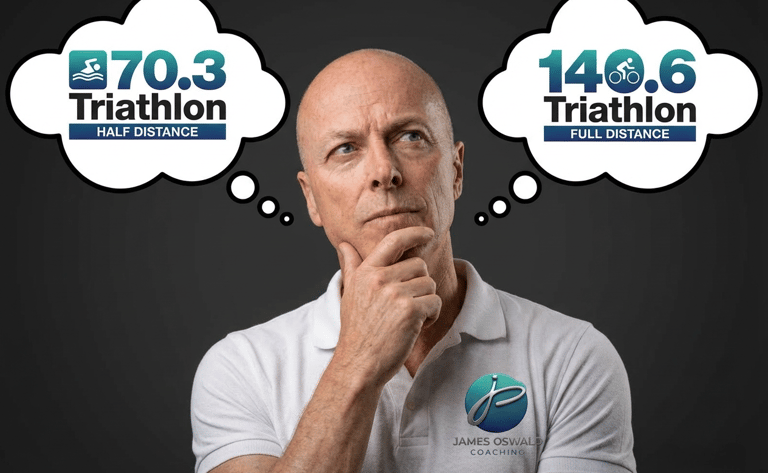
Should I do a 70.3 or go all-in on a full Ironman?
You don’t want to choose something “too easy.”
You don’t want to sign up for something that crushes your life for 9 months.
And you definitely don’t want to DNF because you underestimated the distance.
Choosing the wrong Ironman distance can cost you time, money, fitness momentum, and sometimes confidence.
But let’s fix that.
Why This Happens
Most athletes choose their race distance based on emotion, not strategy.
Common triggers:
A friend signs up for a full Ironman.
A bucket-list mindset (“I just want to say I did it.”)
Social media hype.
A few too many drinks on a Friday night
Ego getting in the way of commonsense
Fear of “not being tough enough” if you choose a 70.3.
Underestimating how much life bandwidth Ironman training requires.
But here’s the reality:
Ironman success isn’t about motivation. It’s about alignment.
Alignment between:
Your current fitness
Your available training time
Your injury history
Your family/work commitments
Your long-term athletic goals
Without alignment, even talented athletes burn out.
What Most Athletes Do Wrong
1. They Choose Based on Ego
They assume full Ironman is the “real” goal and 70.3 is a stepping stone.
Truth: A well-executed 70.3 is just as demanding, and often raced at higher intensity.
2. They Underestimate Training Load
70.3 peak weeks: ~8–12 hours (age-group average)
Ironman peak weeks: ~12–16+ hours
Albeit these hours differ depending where you are in your training plan and how far out from the race you are.
That’s not just more volume, it’s more fatigue management, fueling practice, expense, and recovery discipline.
3. They Don’t Consider Recovery Cost
A full Ironman can require:
2–4 weeks of meaningful recovery
Hormonal and immune system stress
Higher injury risk during build phase
A 70.3 allows:
Faster recovery
More race opportunities per year
Better long-term consistency for newer athletes
4. They Ignore Their Experience
If you’ve:
Never raced a triathlon
Never trained over 10 hours/week
Struggled with running injuries
Jumping straight to Ironman may not always be the smartest progression.
Step-by-Step Solution: How to Choose the Right Distance
Step 1: Audit Your Weekly Availability
Be honest.
How many hours can you train consistently for 6+ months? A rough idea of the dedication required might be:
6–8 hrs/week → Sprint/Olympic
8–12 hrs/week → 70.3 is ideal
12–16+ hrs/week → Ironman becomes realistic
Consistency over heroic weeks, remember you can’t binge train.
Step 2: Assess Your Aerobic Base
Ask:
Can you comfortably ride 3 hours?
Can you run 90 minutes without injury?
Have you raced Olympic distance?
If no, 70.3 may be your smarter first long-course step.
Step 3: Clarify Your Goal
Are you aiming to:
Finish?
Compete for age group?
Qualify?
Experience the challenge?
Full Ironman for the majority is an event experience, a once in a lifetime achievement. A 70.3 can be a performance-focused race, where you can return on numerous occasions to chase that PB or new course.
Different mindset. Different preparation.
Step 4: Consider Life Stress
Training stress + life stress = total stress.
It’s not just the increased physical stress that the training puts the body under, but the additional situational stresses of having to balance and juggle the increased demands of training with that of everyday family, social, work, and life commitments.
If you’re:
In a busy career phase
Parenting young kids
Moving, launching a business, or traveling frequently
A 70.3 may support long-term consistency better.
Don’t get me wrong an Ironman is definitely doable, but it must fit your season of life.
Step 5: Think Long-Term
You don’t have to do Ironman this year.
Many athletes benefit from the same build up I completed ahead of Ironman Vichy:
Year 1 → Olympic distance
Year 2 → 70.3
Year 3 → Ironman
Progression builds durability and confidence. It becomes balanced, sustainable and repeatable.
An Ironman isn’t just more training; it’s more life integration. It can literally take over your life, and there are reasons the merchandise store sells the tongue in cheek t-shirts with the ‘Iron-Widow’ logo on the front.
FAQ Section
Is a 70.3 “easier” than a full Ironman?
Shorter doesn’t mean easier.
70.3 is raced at higher intensity. It hurts in a different way.
Should I do a 70.3 before a full Ironman?
This is strongly recommended for most athletes. It teaches:
Pacing
Nutrition
Race execution
Long-course mental strategy
Transition techniques
Can beginners do a full Ironman?
Yes it is possible but usually only with:
6–9 months structured training
Injury resilience
Realistic expectations
Strong recovery habits
Support and understanding of loved ones and family
What if I’m scared to commit to Ironman?
That’s normal. It’s a big goal, but is achievable if you acknowledge the dedication required.
The question isn’t “Am I tough enough?”
It’s “Is this the right progression right now?”
Which distance is better for long-term performance?
For most age-group athletes:
Multiple strong 70.3 seasons is better for long-term development, rather than rushing to one Ironman and burning out, or having such an experience that puts you off long-course for life.
Final Thought
The “right” distance isn’t about proving something.
It’s about building momentum.
Choose the race that:
Fits your life
Supports consistency
Builds durability
That you have the time and passion to enjoy the training as well as race day.
Leaves you hungry for the next one
Not the one that looks the most impressive on Instagram, or you get the M-dot tattoo sooner.
Still unsure then follow up
If you’re unsure which distance fits your current fitness and life demands, I help athletes map out the right progression, not just the biggest goal.
Whether you’re targeting your first 70.3 or planning your debut Ironman, structured coaching can:
Prevent overtraining
Optimise training hours
Build race-specific endurance
Improve pacing and fueling strategy
Message me at james@jamesoswaldcoaching.com to schedule a performance consultation and let’s choose the distance that sets you up for enjoyable success, not just survival.