*** Free consultation ***
Mastering Your Performance: A Guide to Triathlon Training Zones and Zonal Training
In this coaching guide, we break down zonal training and explain how to use data and perceived effort to train smarter and perform at your best on race day.
TRAINING ZONESTRAININGINDIVIDUALISED COACHINGCYCLING
James Oswald, Coach
2/14/20263 min read
Mastering Your Performance: A Guide to Triathlon Training Zones
To train effectively for a triathlon, you cannot simply "go hard" every day. Success requires a structured approach using intensity zones. These zones ensure you build necessary endurance, improve speed, and avoid the burnout or injury associated with overtraining.
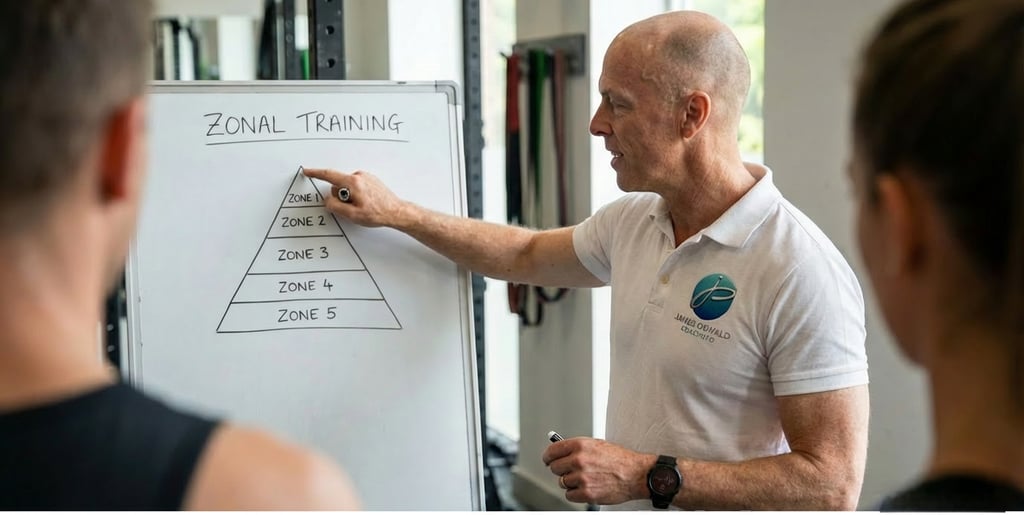
1. The 5-Zone System
Most triathletes use a five-zone model based on heart rate, power (cycling), or pace (running/swimming).
• Zone 1: Recovery (50–60% of Max HR)
Used for warm-ups, cool-downs, and active recovery days. It flushes out metabolic waste without adding fatigue.
• Zone 2: Aerobic Base (60–70% of Max HR)
This is the "bread and butter" of triathlon training. This zone builds mitochondrial density and teaches your body to burn fat as fuel. Most of your training should happen here.
• Zone 3: Tempo (70–80% of Max HR)
Often called "grey zone" training. It’s faster than base pace but not quite an interval. Use it sparingly to build muscular endurance for longer races like 70.3s.
• Zone 4: Threshold (80–90% of Max HR)
The point where lactate begins to accumulate faster than it can be removed. Training here improves your "top-end" aerobic capacity and sustained race speed.
• Zone 5: Anaerobic/VO2 Max (90–100% of Max HR)
Short, high-intensity intervals. This develops maximum power and speed, essential for finishing kicks and short-course racing, but should also be used early in a set to prime the body ahead of a different zone workout.
2. Why Zones Matter
Training by zones prevents the common mistake of "middle-intensity" training, where your easy days are too hard to allow recovery, and your hard days aren't hard enough to trigger adaptation. As mentioned earlier, you may hear this called ‘grey miles’ or ’grey training’.
Historically people tended to follow an 80/20 rule (80% easy, 20% hard), where you maximize physiological gains. Zone 2 builds the engine, while Zone 4 and 5 tune it for performance. The growth of the availability of technology and the data supplied, allows us to be more scientific in the balance between the utilisation of the different zones when training.
3. Establishing Your Zones
To find your specific numbers, don't rely on generic formulas like "220 minus age." Instead, perform field tests such as:
• Swim: A 1,000m time trial.
• Bike: A 20-minute Functional Threshold Power (FTP) test.
• Run: A 30-minute solo time trial to find your Lactate Threshold Heart Rate (LTHR).
If you struggle to gain the your zones then you can look to use a more basic but valuable approach of RPE (Rate of Perceived Effort) when evaluating or logging your sessions or communicating with your coach.
RPE (Rate of Perceived Effort) is one of the most powerful tools in triathlon training, especially for online coaching through the likes of TrainingPeaks. As a coach is valuable to understand the perceived effort an athlete feels a session ha required. This aids conversations and adapting and carrying out of future sessions.
It’s simple, flexible, and extremely effective when used properly.
Here’s how it works and how you can used by athletes.
What Is RPE?
RPE = how hard a session feels on a scale.
Instead of using:
· Heart rate
· Power
· Pace
You use:
· Internal effort perception
It’s especially useful when:
· Athletes don’t have power meters
· Conditions vary (heat, hills, wind)
· Athletes are travelling
· You want to build body awareness
The Standard 1–10 RPE Scale (Best for Triathlon)
This is the most practical scale for endurance athletes:
RPE 1–2 – Very Easy
· Recovery pace
· Full conversation
· Nose breathing
· Could go for hours
RPE 3–4 – Easy Aerobic
· Comfortable
· Can speak in full sentences
· Zone 2 effort
· Base training pace
RPE 5–6 – Moderate / Tempo
· Breathing deeper
· Short sentences
· Sustainable 45–90 minutes
· “Comfortably hard”
RPE 7–8 – Threshold
· Hard but controlled
· Few words at a time
· Sustainable 10–30 minutes
· Race pace for shorter events
RPE 9 – Very Hard
· Max sustainable effort for 2–5 minutes
· VO2 max intensity
RPE 10 – All Out
· Sprint
· Cannot talk
· Max effort 10–60 seconds
Why RPE Is Powerful for Triathletes
1. It adapts to fatigue
2. It accounts for heat and terrain
3. It teaches pacing awareness
4. It prevents over-reliance on numbers
5. It works in all three sports
Conclusion
Ultimately, mastering your training zones is about training with intention, not emotion. When you understand how each zone develops a specific physiological system, and combine objective data with subjective tools like RPE, you gain control over your progress. Instead of guessing, you execute. Instead of overreaching, you adapt. Train smart within the right zones, and you’ll arrive at the start line not just fit, but fully prepared to perform. James Oswald Coaching can support you with individualised training plans that take your training zones into account, and therefore help you get the most out of every training hour.
How do you plan ‘zonal training’ into your training calendar, or do you not think about it at all?