*** Free consultation ***
The Importance Of The Correct Taper
Due to timings this weeks Friday Blog, is coming out 5 days earlier for good reason (Manchester Marathon runners, may have realised why). After months of hard training, bad weather, early starts, and late nights, the final few weeks before your marathon can feel unfamiliar and even uncomfortable for many. The urge to keep pushing is strong, but this is exactly where the taper comes in. Often underestimated, a well executed taper is what allows all your hard work to come together on race day. In this blog, I break down why tapering matters, how to get it right, and how to arrive at the start line feeling fresh, confident, and ready to perform at your best.
FUELLINGPERSONALISED COACHINGMARATHONTRAINING140.6RACE DAYRUNNINGREST
James Oswald, Coach
4/6/20263 min read
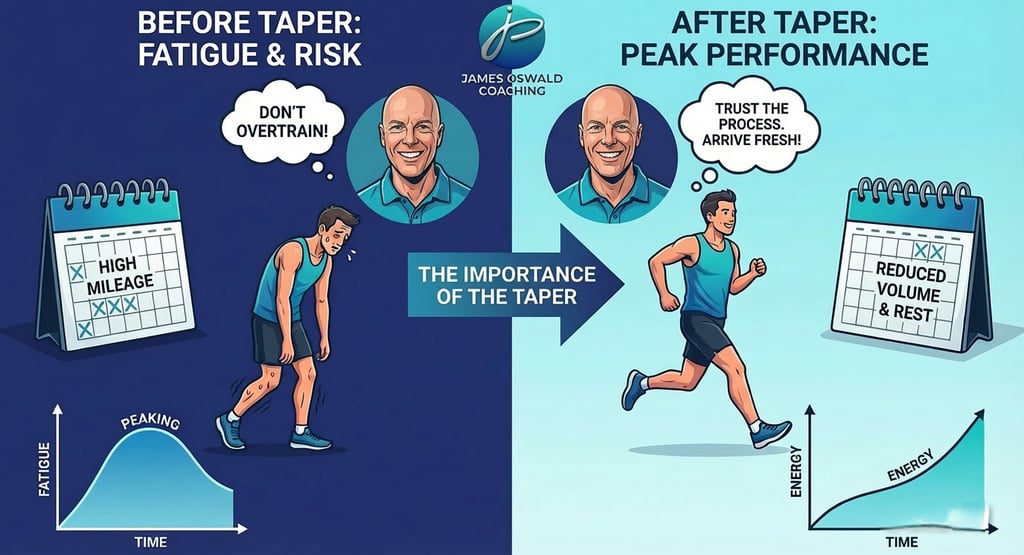
The weeks leading up to your marathon can feel like a strange mix of excitement, doubt, and restless energy. After months of consistent training, bad weather, long runs, early mornings and late nights, you’re suddenly being told to… "do less". It might feel wrong, but this phase, known as the 'taper', is one of the most important parts of your entire training cycle.
What Is a Taper, Really?
A taper is a deliberate reduction in training volume and intensity in the final two to three weeks before race day. The goal isn’t to lose fitness, it’s to allow your body to recover, repair, and arrive at the start line in peak condition, and allowing you to perform at your best.
During the heavy training loads you've become used to, your body is constantly under stress. Muscles accumulate micro-damage, glycogen stores get depleted, and fatigue quietly (or not so quietly) builds up. The taper gives your body the time it needs to repair that damage, restore energy reserves, and rebalance your systems so you can perform at your best.
Why Getting It Right Matters
A good coach will formulate a personalised tapering plan and can help ensure you execute it correctly. After- all a well-executed taper can be the difference between hitting your goal and struggling through the final miles. When done correctly, you’ll feel fresher, stronger, and more responsive on race day. Your legs feel less heavy and regain their 'snap', your mind feels clearer, and your energy levels are fully topped up.
On the flip side, tapering poorly can leave you feeling flat, sluggish, or even still fatigued. Cut too much too soon, and you might feel off the pace from the start. Do too little, and you carry unnecessary fatigue into the race. It’s a fine balance to get right, but definitely one worth taking the time to plan and carryout correctly.
The Biggest Taper Mistakes
One of the most common mistakes is panic training. That sudden urge to squeeze in “just one more long run” or an extra hard session can undo weeks of preparation. Trust the work you’ve already done, and the plan your followed. Fitness isn’t built in the final weeks, but it can definitely be lost through overtraining or injury.
Another trap is doing the opposite and becoming completely inactive. While rest is essential, stopping entirely can make your body feel stiff, sluggish, and switch off. The key is to maintain some intensity while reducing overall volume, keeping the body primed without adding fatigue.
And then there’s the mental side. Many runners experience what can be described as “taper madness”. A mix of self-doubt, overthinking, and phantom aches. Slight twinges or sniffles that you'd normally not notice, suddenly become the only thing you think about. This is normal, and you're not alone. Your body is adjusting, and your mind suddenly has more space to wander. Stay focused on your plan and avoid the temptation to second-guess yourself. My previous Blog on 'Preparing Mentally For A Big Sporting Challenge' gives some additional support in this area.
How to Taper Effectively
As discussed, getting it right matters. A good taper typically reduces your mileage gradually over two to three weeks, while keeping some shorter, sharper sessions in place. Long runs become shorter, workouts become more focused, and recovery becomes a priority.
Sleep, nutrition, and hydration all play a bigger role during this period. This is when your body is doing the crucial work of rebuilding and storing energy. Prioritise quality sleep, eat well-balanced meals, and ensure you’re properly fuelling your body, especially in the final days leading into the race.
It’s also a great time to dial in the details ahead of the big day. Confirm your race-day nutrition based on what you've been using in training, check your kit and get it ready, plan your pacing strategy, read your event joining instruction and visualise the course. Confidence comes from preparation, and the taper is when everything comes together.
Trust the Process
Perhaps the hardest part of tapering is trusting that doing less is actually doing more. It goes against everything you've been thinking for the past months. It requires discipline to hold back when you feel good, and patience when you feel off. But this is where the magic happens, where your body absorbs all the hard work you’ve put in. During training I tell athletes to "believe in the process" in terms that the correct structured training plan will get them to where you need to be. In the same way, athletes need to also 'trust the natural process' of tapering, however wrong it feels at the time.
On race day, a proper taper allows you to step onto the start line not just fit, but ready. Ready to perform, ready to push, and ready to make all those training miles count. This is now your 'lap of honour', celebrating all your hard work and dedication.
So in the final weeks of your preparation when the time comes to strategically 'ease off', embrace it, don't fight it. Your future marathon self will thank you.